

 Facebook
 X
X
 Pinterest
 Copy Link

If you’ve been watching mortgage rate news this August, you’ve probably seen a headline like this: Treasury yields hit a multi-decade high, and the U.S. Treasury Department stepped in to announce it would “at least double” its purchases of long-term bonds.
It sounds like inside-baseball economics — but it’s actually one of the more direct levers behind whether your mortgage rate goes up or down. Here’s the plain-English version.
Mortgage rates don’t follow the Fed. They follow the 10-year Treasury.
A common misconception is that the Federal Reserve sets mortgage rates. It doesn’t — not directly, anyway. Mortgage rates track the 10-year Treasury yield far more closely than the Fed’s benchmark rate.
Why? Lenders bundle mortgages into bonds (called mortgage-backed securities) that compete for the same pool of investor money as U.S. Treasury bonds. When Treasury yields move, mortgage rates tend to move with them, usually running about 1.5–2 percentage points above the 10-year yield.
So to understand where mortgage rates are headed, you have to understand what’s driving Treasury yields.
The key rule: bond prices and yields move in opposite directions
This is the part that trips most people up, so let’s slow down.
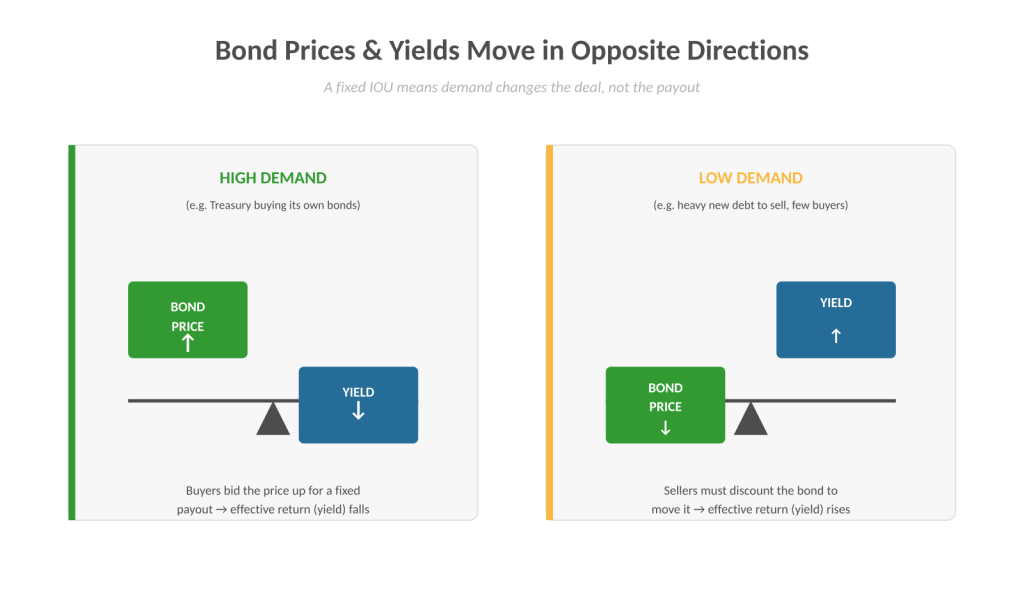
Imagine a bond as a fixed IOU: it promises to pay you a set amount down the road. The price you pay for that IOU today can change — but the payout at the end doesn’t.
- If a lot of people want that bond, they bid the price up. But since the payout is fixed, paying more for the same eventual payout means your effective return — the yield — goes down.
- If few people want it, sellers have to drop the price to attract buyers. A lower price for the same fixed payout means the yield goes up.
Why yields spiked this August
Right now, the federal government is running large deficits, which means it has to sell a lot of new debt to cover its bills. On top of that, elevated oil prices from the ongoing conflict in Iran have kept inflation worries elevated. Both factors made investors more cautious, pushing the amount of new supply up and demand relatively softer — and when supply outpaces demand, sellers have to offer a higher yield to move the debt. That’s exactly what happened: the 30-year Treasury bond touched a 19-year high in mid-August.
So what did the Treasury actually do?
The Treasury Department announced it would significantly increase its own purchases of long-term bonds — essentially stepping into the market as a large, motivated buyer.
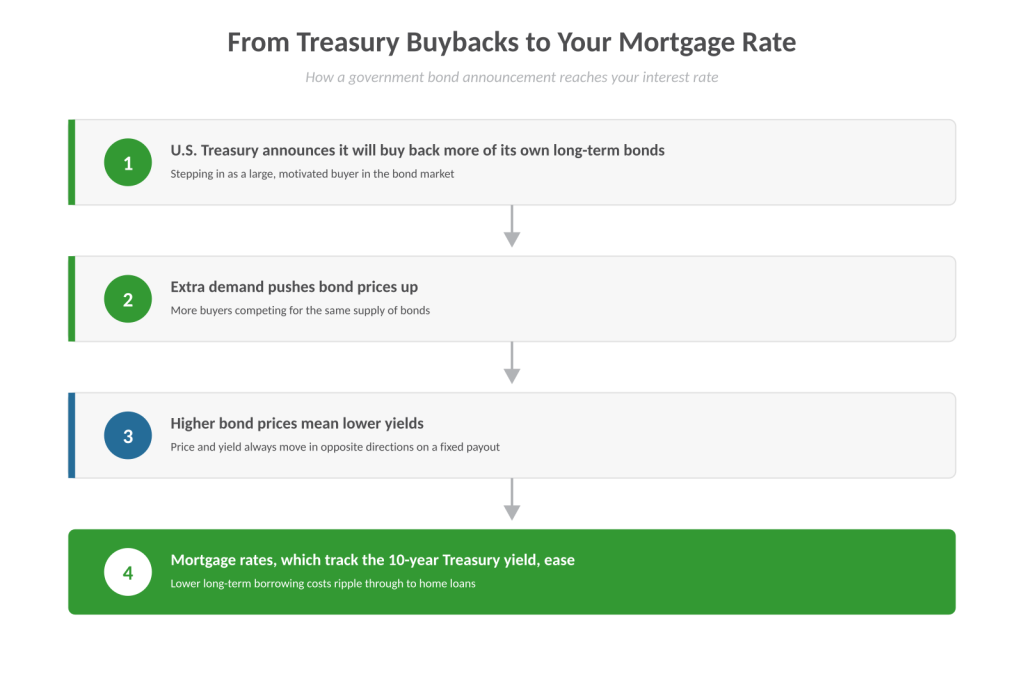
That single move sets off a chain reaction:
- The Treasury buys more of its own long-term bonds, acting as extra demand in the market.
- That added demand pushes bond prices up.
- Higher bond prices mean lower yields — remember, price and yield move in opposite directions.
- Mortgage rates, which track the 10-year Treasury yield, ease as a result.
The farmer’s market version
If the mechanics still feel abstract, here’s the analogy we like to use:
Picture a farmer’s market selling government IOUs. Right now the government needs to sell a lot of them to cover its bills, so it has to sweeten the deal — offer a higher interest rate — to get people to buy them all. That’s rates going up.
Now imagine a huge buyer walks in and starts snapping up a big chunk of that supply. Suddenly there’s less sitting around unsold, so the government doesn’t have to sweeten the deal as much anymore — the rate comes down.
That’s basically what the Treasury just announced: stepping in as a big buyer of its own long-term bonds to try to keep those rates — and by extension, mortgage rates — from climbing too fast.
What this means for buyers and sellers right now
This kind of intervention doesn’t flip mortgage rates overnight, but it does help put a ceiling on how high they climb in the short term. If you’re timing a purchase or a refinance, it’s a good reminder that mortgage rates respond to forces well beyond the Fed’s meeting calendar — bond market supply and demand, geopolitical events, and inflation expectations all play a role.
We’ll keep tracking this — and the rest of what’s moving housing — every month on the Housing Market Update. Catch the full conversation and more market analysis at HMupdate.com, and subscribe on YouTube to get each episode as it drops.
For educational purposes only; not financial or legal advice.


