

 Facebook
 X
X
 Pinterest
 Copy Link
I live about an hour from Manhattan. Close enough that the city is always within reach, yet far enough that when I go, I want to make it count. This past weekend, my wife Laura and I did exactly that — and what unfolded over two days on Fifth Avenue turned into one of the most fascinating urban experiences I’ve had in years.
It started with a walking tour we booked through TripAdvisor called the Gilded Age Mansions Tour in New York. I didn’t know exactly what to expect. I knew the Upper East Side was home to some of the most storied real estate in American history. What I didn’t fully appreciate — until I was standing inside these buildings — was just how breathtaking that history truly is.
The Andrew Carnegie Mansion
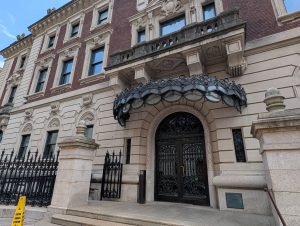 Our first stop was the Andrew Carnegie Mansion at 2 East 91st Street, now home to the Cooper Hewitt Smithsonian Design Museum. From the street, the building commands your attention — particularly the entrance canopy, a sweeping masterpiece of ornate ironwork designed by Tiffany & Company. It is the kind of detail that makes you stop mid-stride on a busy sidewalk.
Step inside and the grandeur only deepens. The entrance hall features floor-to-ceiling hand-carved walnut paneling, a sweeping red-carpeted staircase with an intricate wrought iron balustrade, and a coffered ceiling that feels more cathedral than residence. The ornate iron doors — photographed from the interior — are as much sculpture as architecture.
Carnegie built this mansion in 1902 and at the time it was one of the most technologically advanced private residences in the world — the first private home in New York City with a steel frame, a passenger elevator, and central heating. The man who built it was, of course, one of the wealthiest people who ever lived — and it shows in every square inch.
Villa Albertine and the Forgotten Michelangelo
 From Carnegie’s mansion we made our way to Villa Albertine at 972 Fifth Avenue — formerly the Payne-Whitney Mansion, one of the most magnificent Beaux-Arts townhouses ever built in New York City. Today it serves as the cultural services offices of the French Embassy in the United States.
The interiors stopped us cold.
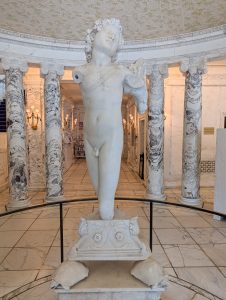
The rotunda features soaring marble Ionic columns, a delicately painted plaster ceiling, and at its center — a marble sculpture that carries one of the most remarkable backstories in the art world. For almost a century, this sculpture stood quietly in the foyer of this very mansion, attracting little attention — simply a decorative piece in the background of life. That is, until a name was given to its creator: Michelangelo.
The information card at The Met dates the sculpture to circa 1490, when Michelangelo would have been a teenager, making it one of his earliest works. What we saw inside Villa Albertine is a replica — the original now lives on permanent loan at The Metropolitan Museum of Art. But standing in the very rotunda where this sculpture resided unrecognized for nearly a century is a remarkable experience in itself. untappedcities
And then there was the mirrored room. Words almost fail here. Every wall, every surface covered in gilded mirrors, ornate gold molding, painted ceilings, period furniture, and a fireplace that could anchor a ballroom. It is the kind of room that makes you feel like you have stepped into Versailles — on Fifth Avenue, in the middle of Manhattan.
The American Irish Historical Society
 A short walk down Fifth Avenue brought us to 991 Fifth Avenue — home of the American Irish Historical Society, its beautiful red brick Beaux-Arts facade flying both the American and Irish flags side by side. A quiet but powerful reminder of the deep thread of Irish heritage woven into the fabric of New York City’s history.
The Guggenheim
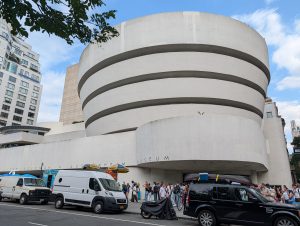
Just steps away stood one of the most iconic buildings in the world — The Solomon R. Guggenheim Museum, Frank Lloyd Wright’s masterpiece. That spiraling cylindrical form against a blue summer sky is one of those images that never gets old no matter how many times you’ve seen it.
St. Patrick’s Cathedral and Grand Central Terminal
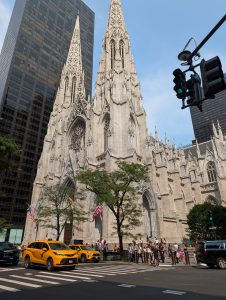 Heading south on Fifth Avenue, St. Patrick’s Cathedral rose against the midtown skyline — its soaring Gothic spires a stunning counterpoint to the glass and steel towers surrounding it. There is something deeply moving about the way this building holds its own amid the relentless energy of midtown Manhattan.
We ended our second day at Grand Central Terminal — and if you haven’t stood in the main concourse recently and simply looked up, you owe it to yourself. That turquoise celestial ceiling, those massive arched windows flooding the space with light, the famous gold clock at the center of the floor. It is one of the greatest public spaces ever built, and it never disappoints.
And then there was the Flatiron Building — still under renovation, still magnificent, that impossibly narrow triangular wedge cutting through the intersection of Fifth Avenue and Broadway like the prow of a ship.
The Louis Vuitton Building — and the Best Barricade in History
I have to save the best for last.
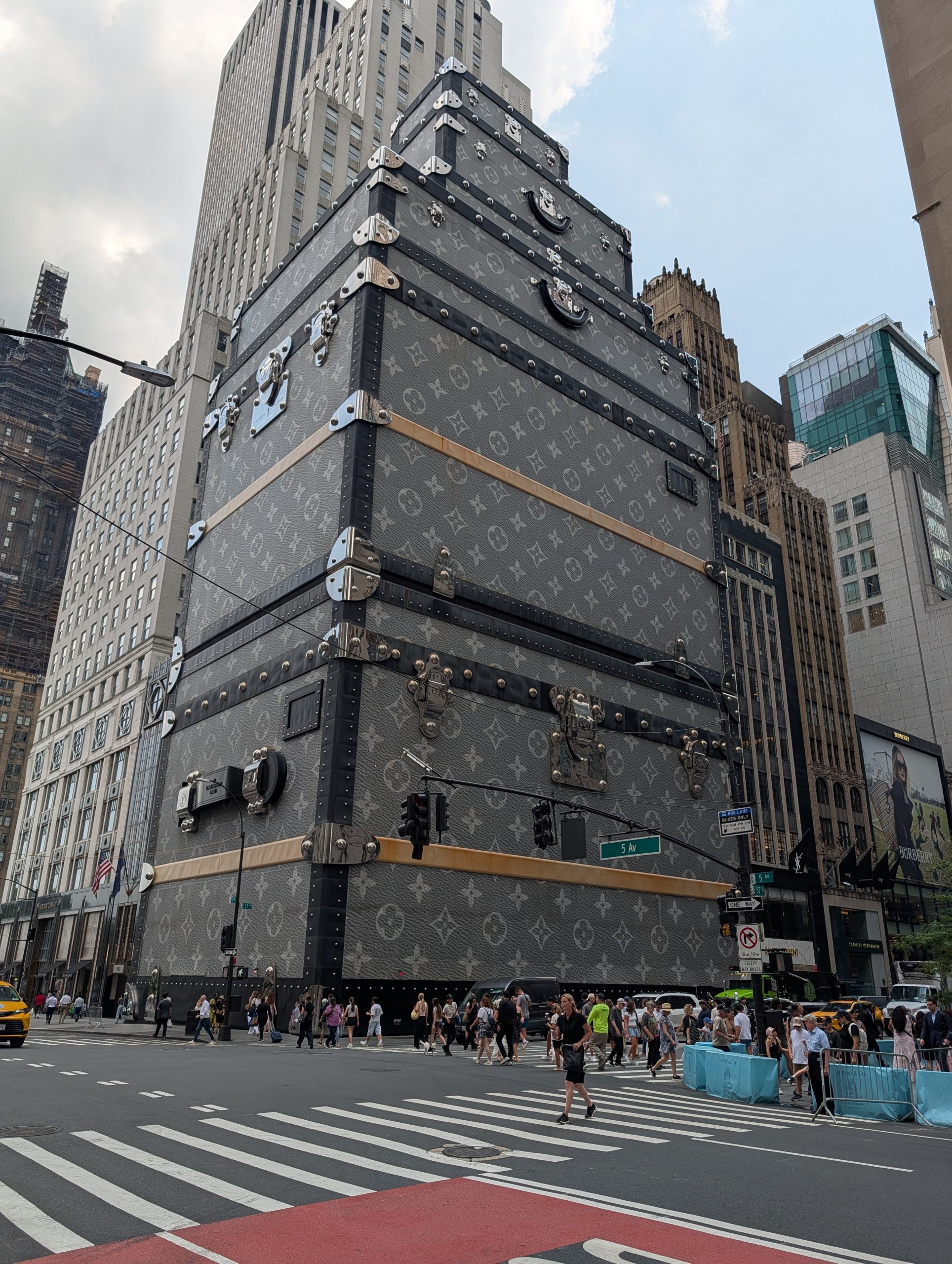
 Walking down Fifth Avenue on day two, I turned a corner and stopped dead in my tracks. The Louis Vuitton flagship store — an entire Manhattan skyscraper — had been wrapped to look like a towering stack of giant Louis Vuitton trunks. Multiple stories. Stacked. With hardware, clasps, buckles, and the iconic LV monogram covering every surface from sidewalk to roofline.
I spent years in commercial real estate as a leasing agent. Part of that work involved managing vacant storefronts during renovation — what we call barricades. Getting a developer to spend real money on a creative barricade was always a battle. Most of the time you got plain plywood or a basic printed wrap and called it a day.
What Louis Vuitton did here is in a category entirely its own. This wasn’t a barricade. This was a statement. A piece of brand storytelling so bold and so beautifully executed that it stopped thousands of people on one of the busiest streets in the world and made every single one of them reach for their phone.
As a business owner and entrepreneur, I have enormous admiration for that kind of vision. The willingness to invest in the extraordinary when ordinary would have been perfectly acceptable. That is the difference between a brand and a legend.
New York City never stops surprising me. Two days, one extraordinary avenue, and a reminder that the greatest city in the world always has something new to show you — even when you think you’ve seen it all.
If you haven’t done the Gilded Age Mansions Tour on Fifth Avenue — book it. It is absolutely worth every minute.
Geoff Green is President of Better Homes and Gardens Real Estate Green Team, serving Orange County, NY and surrounding communities. Follow his adventures at RealEstateGeoff.com.


